There’s a point in training where doing more isn’t the answer… refining how you organize yourself is.
In Chinese medicine, the Eight Extraordinary Vessels aren’t just theoretical pathways. They represent how your body stores, regulates, and integrates energy over time. If the 12 primary meridians are your day-to-day circuitry, these eight are your master regulators the deeper system that determines posture, resilience, recovery, and adaptability.
The value of understanding them isn’t academic… it’s practical.
When you begin to train awareness through these vessels, a few things start to shift:
- Your posture becomes effortless instead of forced
- Your breath naturally deepens without trying
- Movement becomes more connected and efficient
- Your nervous system stabilizes under pressure
You stop “trying to perform”… and start organizing your body in a way that performance emerges naturally.
Let’s walk through them in a way you can actually use.
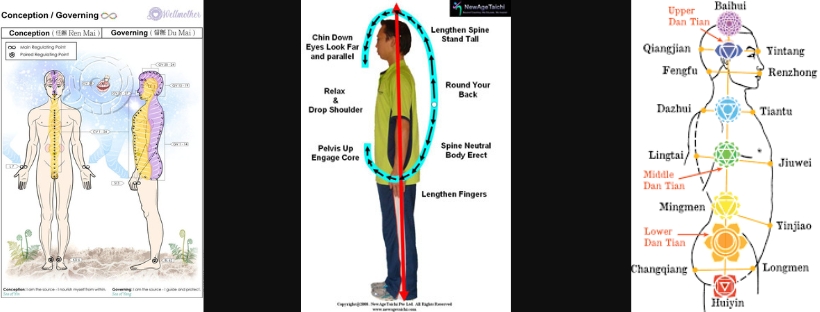
Everything begins here.
The Governing Vessel (Du Mai) runs along the spine and supports structure, alertness, and upright posture. The Conception Vessel (Ren Mai) runs along the front body and governs breath, internal organs, and recovery.
When these two are working together, you feel both lifted and relaxed at the same time.
Simple practices:
Stand with your spine naturally aligned… not rigid, just organized. Let your chest soften and your breath drop into the lower abdomen. As you breathe, bring light awareness up the spine on the inhale and down the front on the exhale.
Even a few minutes of this begins to balance activation and relaxation the foundation of all meditative and performance-based training.
The Core Engine: Thrusting Vessel
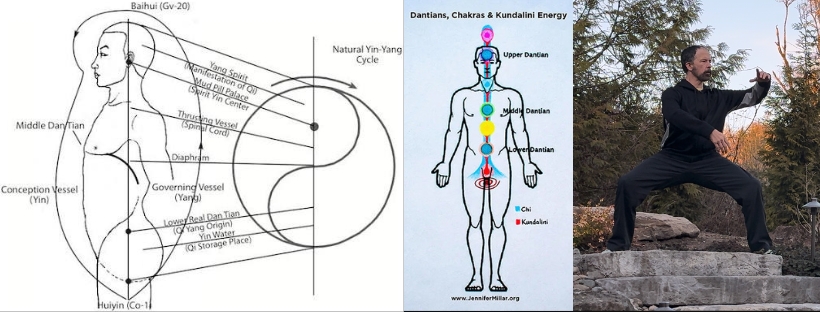
The Thrusting Vessel (Chong Mai) is your centerline power source.
This isn’t surface strength… it’s depth. It’s what allows you to stay calm, stable, and powerful under pressure.
Simple practices:
Breathe into the lower abdomen and expand in all directions—front, back, and sides. Then move slowly—step, squat, or shift your weight—while maintaining that internal pressure.
The goal is simple:
everything moves from the center… nothing collapses inward.
Over time, this builds real internal stability and a kind of quiet strength that doesn’t rely on tension.
The Integrator: Belt Vessel
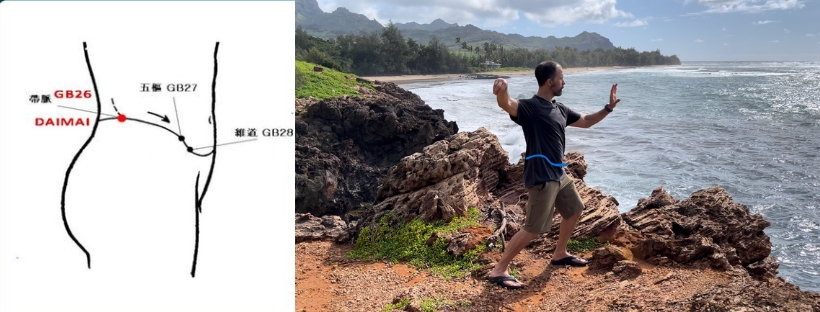
The Belt Vessel (Dai Mai) wraps around your waist and connects the upper and lower body.
If this isn’t functioning well, movement becomes disconnected arms doing one thing, legs doing another. When it’s trained, everything works as a unit.
Simple practices:
Perform slow waist rotations, keeping the shoulders and hips connected. Add gentle spiraling movements—what’s often called silk reeling initiated from the center.
Think of your waist as the hub:
nothing moves independently… everything passes through the center.
This builds coordination, power transfer, and injury resistance.
Movement Balance: Yin and Yang Heel Vessels
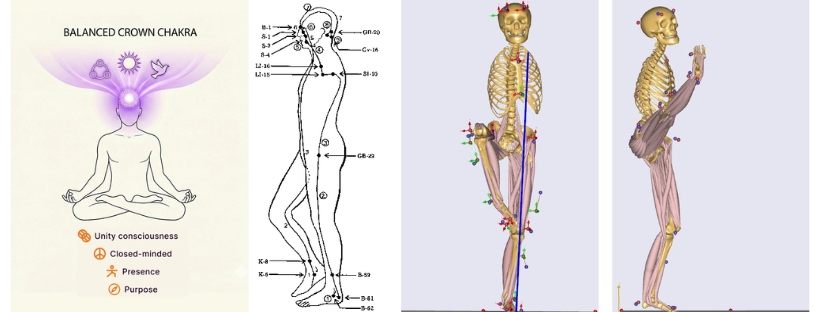
The Yin and Yang Heel Vessels (Qiao Mai) regulate how you balance stillness and movement.
- Yin Qiao → inward, restorative, grounding
- Yang Qiao → outward, active, responsive
Most people are stuck leaning too far in one direction either always “on” or always depleted.
Simple practices:
Practice slow walking meditation with a soft, inward gaze… then contrast it with more alert stepping where your eyes engage the environment.
Add single-leg balance work with relaxed breathing.
The goal is to develop the ability to shift gears smoothly from calm to action, and back again, without friction.
Integration and Awareness: Yin and Yang Linking Vessels
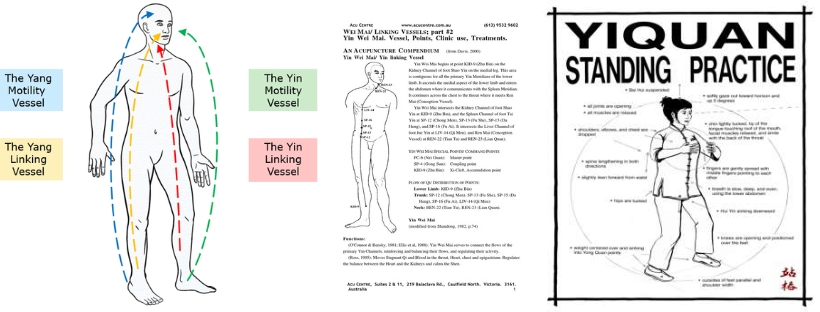
The Linking Vessels (Wei Mai) connect everything together.
- Yin Linking Vessel → your internal world (emotions, breath, heart-mind)
- Yang Linking Vessel → your external world (environment, timing, interaction)
This is where awareness becomes your greatest tool.
Simple practices:
Stand quietly and place awareness in the chest, observing your internal state without trying to change it. Then expand awareness outward—feel the room, the space around you, without reacting.
You’re training two skills:
- Staying steady inside
- Staying aware outside
That combination is what creates presence.
Bringing It All Together
At first glance, the eight vessels can feel like a lot…
But when you simplify them, they become a clear training system:
- Du + Ren → posture and breath
- Chong → core stability and internal power
- Dai → integration and connection
- Qiao → movement balance
- Wei → internal and external awareness
You don’t need to master all of this at once.
Start small.
Stand for a few minutes each day… align your structure… breathe into your center… move slowly with awareness… and expand your perception just a little beyond yourself.
Over time, something shifts.
You stop chasing results…
and your body begins to organize itself in a way where results show up on their own.
That’s the real benefit of understanding these vessels…
Not more information…
but a deeper way to train, feel, and live.
You can understand these ideas intellectually… but the real shift happens when you practice them consistently and feel the changes in your own body.
If you’re ready to take these principles beyond awareness and turn them into something you live and train every day, explore the Qigong Mastery Program.
It’s a step-by-step system designed to help you build an evolving life practice—so your structure, breath, energy, and awareness begin to organize naturally, without forcing it.
If you apply it… it has the potential to become one of the most valuable things you’ve ever done for your health, performance, and long-term growth.
See how you can get started today with our new member specials up to 40% off. Click Here…